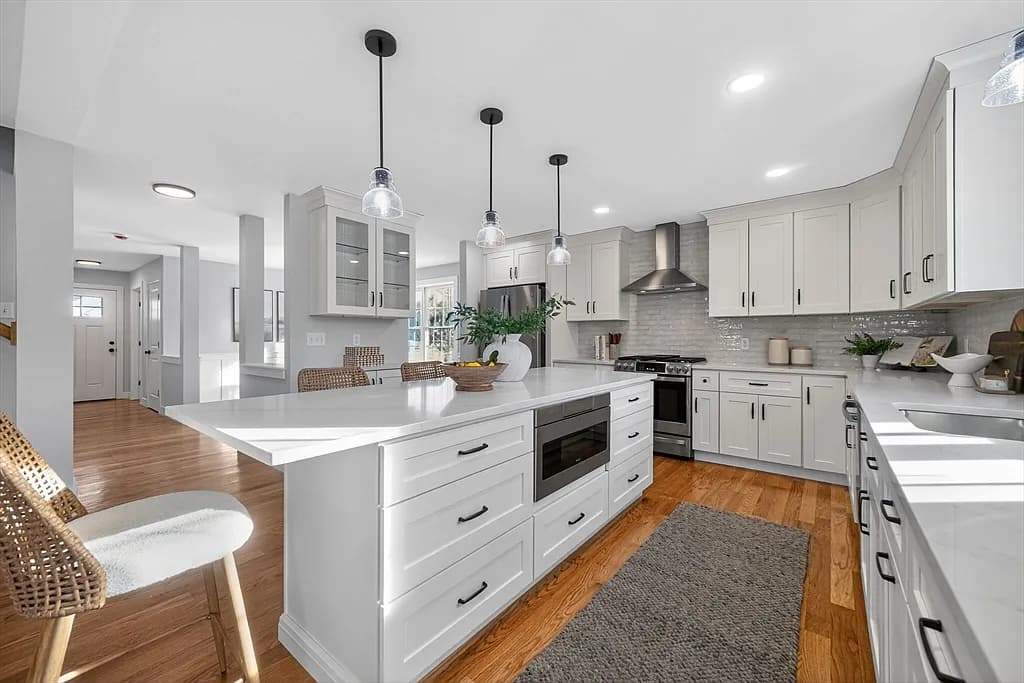
Ask ten contractors what a kitchen remodel costs and you'll get ten different answers — because the honest answer is that it depends. Two kitchens the same size can land far apart depending on what you keep, what you move, and how far you take the finishes. We don't post price ranges here, because a number without a scope behind it just misleads. What we can do is walk you through the things that actually move the cost, so you can plan a budget that fits the kitchen you want.
The size and layout of the space
A bigger kitchen means more of everything — more cabinets, more countertop, more flooring, more tile, and more hours of labor to install it all. Layout matters as much as square footage. A long single run of cabinets is simpler than a kitchen with an island, a peninsula, and a pantry, each of which adds cabinetry, edges, and electrical. The more surfaces and corners there are, the more the material and labor add up.
How much you're moving
Keeping the existing footprint — same sink, same appliance locations, same walls — is the most efficient way to remodel. The cost climbs when you start relocating things. Moving the sink or dishwasher means new plumbing runs. Adding an island with power or a range means new electrical, and sometimes gas. Taking down a wall to open the kitchen to the living space brings in structural work and the finish carpentry to tie it back together. None of that is a reason not to do it — an open, well-laid-out kitchen is often worth it — but it's the single biggest reason two kitchens the same size cost different amounts.
Cabinets and countertops
Cabinets are usually the largest single piece of a kitchen budget, and they span a wide range. The choices that move the number most:
- •Stock, semi-custom, or fully custom cabinetry
- •Countertop material and edge detail — laminate, quartz, and natural stone are very different lines
- •Whether your existing cabinet boxes are sound enough to reface, or need full replacement
- •Add-ons like soft-close hardware, pull-outs, and specialty storage
There's no single right answer here. The goal is to match the cabinetry to how long you plan to stay, how hard the kitchen gets used, and what matters to you visually.
Appliances and fixtures
Thinking about a project like this?
We'll walk your space and put a clear written estimate in your hands.
Appliances are their own budget, chosen by you, and they range widely. Panel-ready and integrated appliances that hide behind cabinet fronts cost more to buy and to install. The same is true of fixtures and finishes — faucets, sinks, lighting, and hardware. Individually they're small; together they add up, and they're some of the easiest places to adjust a budget up or down without changing the bones of the project.
What's behind the walls
Many New Hampshire homes have decades of history behind their kitchen walls. Once demo opens things up, we sometimes find outdated wiring, worn plumbing, or past work that wasn't done to code. We plan for the possibility in older homes rather than getting caught by it — but it's real, and it's why a contingency matters on a kitchen in an older home. We'd always rather fix what we find than paper over it.
Finish level and the details
The last ten percent of a kitchen is where a lot of the character lives — and a lot of the budget. Tile backsplash, under-cabinet lighting, trim and crown, a vent hood that's a feature instead of an afterthought, quality hardware. Each detail is small on its own. Together they're the difference between a kitchen that's finished and one that just functions, and they're worth deciding on early so they're planned in, not tacked on.
How to plan your budget
You don't need a number off a website. You need a clear scope and a few good habits:
- •Decide what's non-negotiable versus nice-to-have before you start.
- •Set aside a contingency for what demo might uncover in an older home.
- •Choose materials that hold up to daily use, not just showroom looks.
- •Get a written estimate with a clear scope, so you're comparing like for like.
The best way to know what your kitchen will cost is to have someone walk it with you. We come out, look at the space and what's behind the walls, talk through your priorities, and put a clear written estimate in your hands — scope, materials, and price, no guessing.
Learn more about our kitchen & bath remodels service.